
Electronic Health Records
EHR and practice management software, built for small practices
Cloud-based EHR and practice management software for small and independent medical practices. ONC-certified, fully configurable, and never a forced bundle.
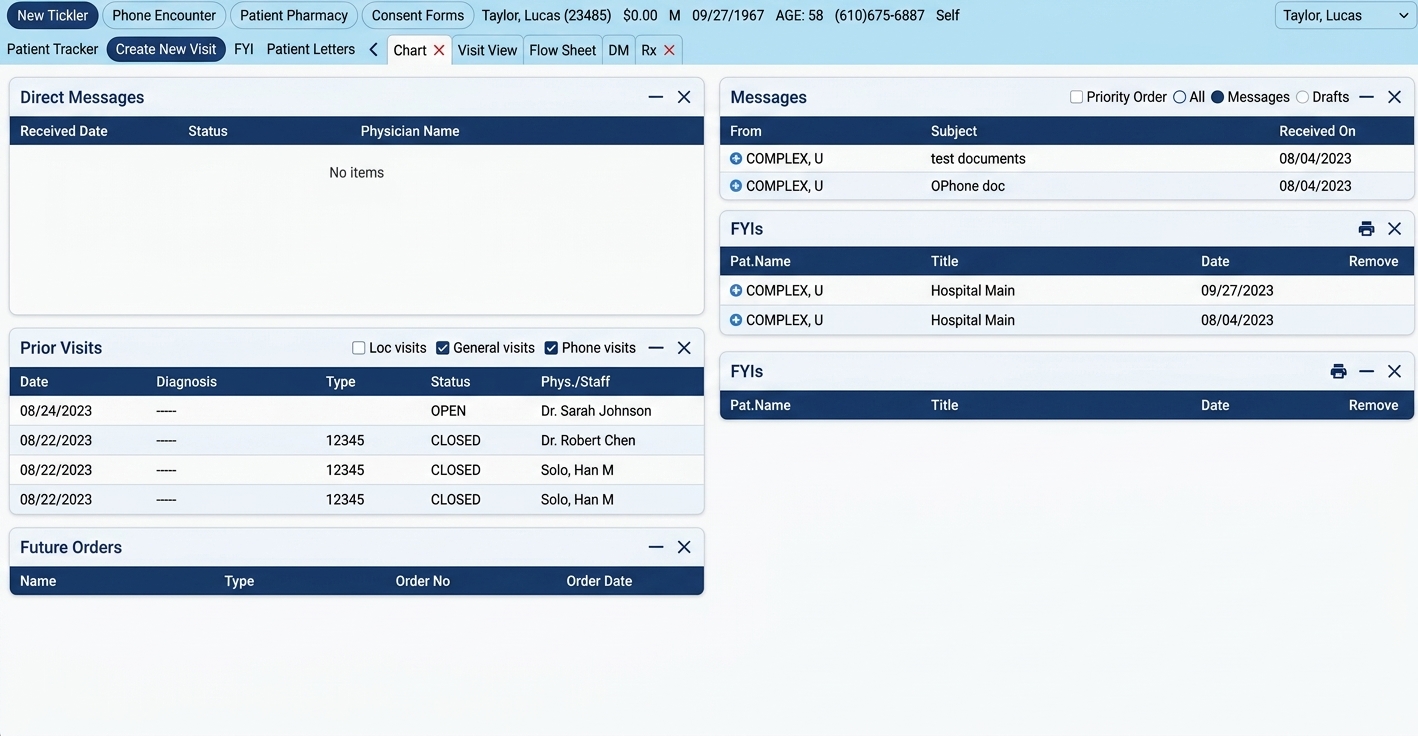
Built for 1-25 provider practices
Not a hospital system scaled down — the only kind of customer Criterions has served since 1991.
Configurable to your specialty
Problem lists, templates, and chart layout adapt to how your providers actually document, across 24 specialties.
License only what you use
EHR, practice management, or both — no forced bundle, no paying for a module you'll never open.
Criterions has been building EHR and practice management software for one kind of customer for 35 years: the independent practice. Not a hospital product scaled down afterward — which is exactly why most electronic health record software feels rigid the moment your workflow doesn't match the template.
Over 660 practices and billing companies run on it today, and because every module is licensed separately, you can take the clinical chart on its own, the billing side on its own, or both, without paying for the half you'll never open.

Practice Fit
Not a hospital system, scaled down
There is a real difference between software designed for a small practice and software designed for a health system and then sold to one. The second kind shows up in the details: workflows that assume a department behind them, configuration screens that assume an IT staff, and support that assumes someone's whole job is the EHR.
Criterions assumes what is actually true of a practice this size — that the person configuring the system is also seeing patients, that nobody has six months for an implementation, and that when something breaks you need a person on the phone rather than a ticket number. That is not a philosophy we adopted. It is the only customer we have had since 1991.
Specialty Configuration
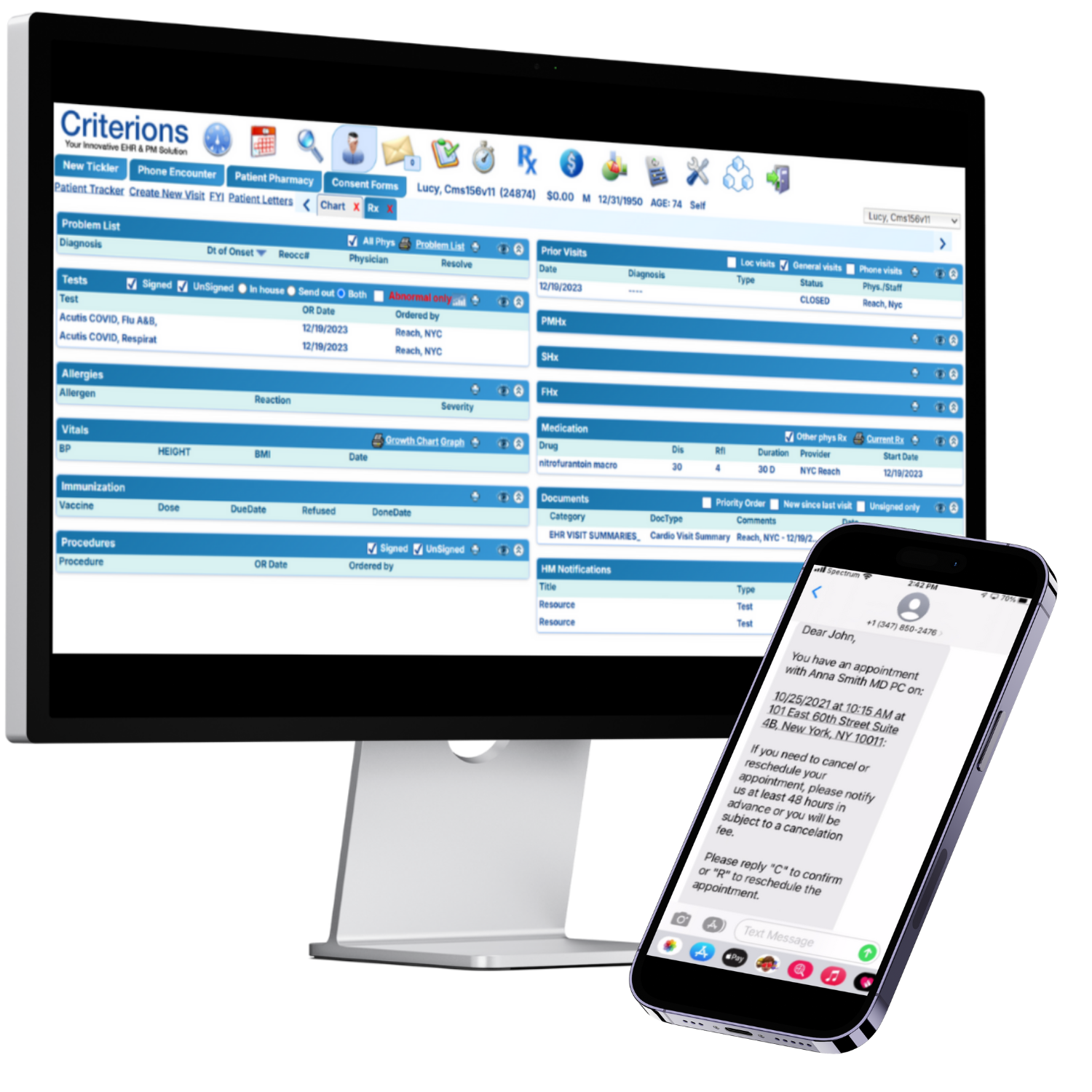
A chart that adapts to your specialty, not the reverse
Problem lists, visit templates, and chart layout are configurable to your specialty and to individual providers' preferences — not locked to a one-size-fits-all default. A podiatry practice and an OB/GYN practice do not document the same way, and neither should have to accept a template built for the other.
The mechanism matters more than the feature list. Most EHRs treat specialty support as a set of pre-built templates you choose from, which works right up until your workflow sits between two of them. Criterions treats the chart itself as configurable, so the question is never "is there a template for us" — it's "how do you want it to look." Criterions serves 24 specialties today, from cardiology and pediatrics to dermatology and podiatry.
Cloud Access
Cloud-based EHR software, with no server in the closet
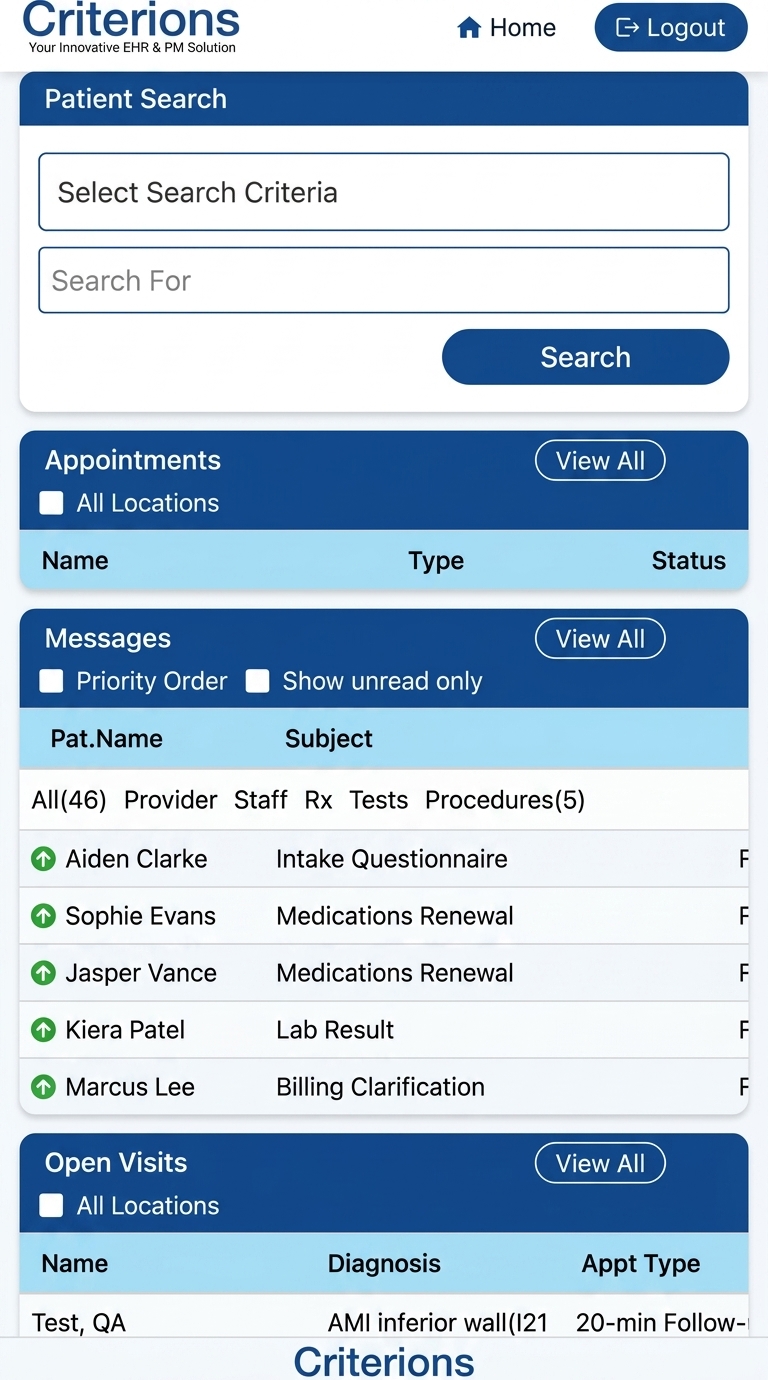
Running your EHR in the cloud means there is no server to patch, no backup to rotate, and no capital purchase every five years when the hardware ages out. Providers reach the chart from the exam room, the office, or home, on whatever device they have.
For an independent practice, this is usually the largest hidden cost in any comparison between two systems — not the license fee, but everything an on-premise option quietly requires you to own, staff, and replace.

Interoperability
Built on the interoperability standards your practice already has to meet
Interoperability isn't really a Criterions feature — it's an industry requirement. The 21st Century Cures Act and ONC certification both require certified EHRs to support standardized data exchange. Criterions EHR meets that with FHIR-based data exchange and direct lab/HL7 interfacing, so results and referral data land in the chart instead of arriving as a fax or a separate portal login.
Direct messaging runs through EMRDirect phiMail Server, and ePrescribing is powered by NewCrop. And because both core products integrate broadly, the systems your practice already depends on generally don't have to be replaced to bring Criterions in.
Compliance built into the foundation
Criterions is compliant with the ONC Certification Criteria for Health IT and has been certified by an ONC-ACB in accordance with the applicable certification criteria adopted by the Secretary of Health and Human Services. Criterions EHR 4.0 Complete EHR Ambulatory holds Certificate No. 15.04.04.2705.Crit.04.00.1.191111, certified 03/21/2014. This certified product-version may require ongoing monthly costs to support online patient service, direct messaging, or ePrescribing.
Beyond certification, Criterions is built with HIPAA in mind across the platform, and we sign a Business Associate Agreement (BAA) with every customer to support your practice's HIPAA compliance program. Full certification details, Real World Testing results, and API documentation are published on our certifications page.
EHR is one core product in the Criterions platform. Pair it with practice management if you need both, or run it on its own with only the features you actually use attached — ePrescribing, the Patient Portal, appointment reminders, or lab and HL7 interfaces.
Most vendors in this category price the other way: one tier, everything in it, whether or not you will ever turn half of it on. If you're a billing company that needs practice management without a clinical chart, or a practice that needs the chart without the billing side, Criterions can be licensed exactly that way.
Features available with EHR and practice management software, built for small practices
Add exactly what your practice needs — nothing you don't.
e-Prescribing software built into the workflow you already use
Send prescriptions electronically without leaving the chart — interaction checking, refill and change requests, and fill tracking, powered by NewCrop.
Explore this featureA certified patient portal, included free with your EHR
A certified patient portal for scheduling, bill pay, records, and secure messaging — included free with Criterions EHR, not billed as a separate module.
Patient appointment reminder software, tied to your actual schedule
Automated text, email, and voice patient reminders tied to your EHR schedule — patients confirm, cancel, or reschedule by reply and the slot updates.
Lab interface software for your EMR, in both directions
Bi-directional lab and HL7 interfacing — orders go out electronically and results come back into the chart automatically. No faxes, no manual re-entry.
Medical scheduling software that shares a record with billing
Provider and resource scheduling on the same record as billing, intake, and reminders — so a schedule change never needs re-entering in a second system.
Digital patient intake software, completed before the visit
Send intake, ID upload, and consent forms by text before the visit — patients complete them on their own phone instead of a waiting-room clipboard.
Ambient AI documentation with DAX Copilot
DAX Copilot listens to the visit and drafts the clinical note, referral letters, and after-visit summaries. The physician reviews and signs off on each.
Frequently asked questions
What is EHR software?+
EHR software — short for electronic health record software — is the system a medical practice uses to create, store, and share patient charts electronically instead of on paper. A certified EHR handles clinical documentation, problem lists, medications, orders, and results, and supports standardized data exchange with labs, pharmacies, and other providers. Criterions EHR is ONC-certified and built specifically for independent and small-group practices.
Can I buy EHR software without practice management software?+
Yes. Criterions is modular — license the EHR on its own, license practice management and medical billing on its own, or run both together. Practices that already have a billing system they're happy with, and billing companies that don't need a clinical chart at all, are both common setups.
Is Criterions EHR ONC-certified?+
Yes. Criterions EHR 4.0 Complete EHR Ambulatory is ONC Health IT certified (Certificate No. 15.04.04.2705.Crit.04.00.1.191111, certified 03/21/2014). Some certified functionality — such as online patient service, direct messaging, or ePrescribing — may require ongoing monthly costs to support.
Can I configure the EHR for my specialty?+
Yes. Criterions EHR is built to be configured around your specialty's workflow rather than forcing your practice into a generic template — from problem lists and visit templates to how the chart itself is laid out.
What does EHR software cost?+
It depends on what you actually license. Criterions is priced modularly — the practice that needs only the chart doesn't pay for billing, and the billing company that needs only practice management doesn't pay for a clinical chart. Some certified functionality, such as online patient service, direct messaging, or ePrescribing, carries ongoing monthly costs. A demo is the fastest way to get a real number for your setup.
Does Criterions sign a Business Associate Agreement (BAA)?+
Yes. Criterions signs a Business Associate Agreement with every customer to support your practice's HIPAA compliance program.
Switching EHRs is the part nobody wants to think about
It's the real reason most practices stay on a system they've already outgrown — not the license fee, but the fear of a migration that eats a quarter and a staff that never adjusts. That's not how this goes: your workflow gets configured before you go live, you license only the modules you need, and support is a person who knows you by name — not a ticket queue.
Every month on a system that fights your workflow is documentation time your providers don't get back and claims sitting in A/R longer than they should. The fastest way to know whether this fits is to see it against your own workflow — your specialty, your templates, your actual claims process.